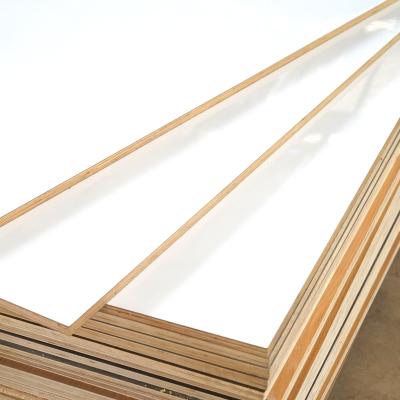
Plywood, a multilayered board we frequently encounter in our daily lives, is actually made of this? What unique advantages does its multilayered structure offer? Let's explore the inner workings of plywood and uncover its structural mysteries.
Plywood Structure Analysis
Plywood is primarily made from multiple layers of veneer sheets through a specialized process. These veneers, typically peeled or sliced from logs, have a thickness ranging from 0.5 to 3 mm. High-quality veneers typically have a thickness of 1.6 to 1.8 mm, exactly the ideal range we strive for.
The key to plywood lies in the perpendicular grain direction of adjacent veneer sheets. This unique structural design not only significantly enhances plywood's strength but also ensures exceptional stability.
Adhesives play a crucial role in plywood manufacturing, ensuring the veneers remain firmly bonded together. Commonly used adhesives include urea-formaldehyde resin glue, phenol-formaldehyde resin glue, and melamine-formaldehyde resin glue, which have been the industry's primary choice for decades. However, with growing environmental awareness, new eco-friendly adhesives have emerged in recent years, such as Lingmei Glutinous Rice Glue, which has attracted widespread attention for its environmental performance and excellent bonding performance.
Veneer paper is the face of plywood, and its importance is self-evident. After meticulous processing such as impregnation and drying, it is carefully applied to the outermost layer of plywood, creating a beautiful and diverse product. Veneer paper is available in a wide variety of patterns and colors, including wood grain imitations, stone grain imitations, and solid colors, offering consumers a wide range of choices to meet the personalized needs of various decorating styles. Qiangyijia offers over 100 different veneer paper patterns, fully demonstrating its deep industry expertise and keen insight into market trends. Plywood, a board material made from multiple layers of veneer glued together, features a characteristic structure characterized by an odd number of layers stacked alternately, such as three, five, or seven. This structure ensures more uniform stress distribution in the board, effectively avoiding the internal stress imbalance caused by a symmetrical number of layers. This ensures the board's stability during use and reduces the possibility of warping and deformation. The emergence of plywood stems from the pursuit of fully utilizing and conserving wood resources. By processing wood into veneers and gluing them together, it was discovered that this method significantly improved the performance of the resulting board. This method of plywood gradually gained industrial application and continued development. With technological advancements, the production process for plywood has become increasingly sophisticated, expanding its application areas.
The Significant Advantages of Plywood
Plywood demonstrates its superior performance in multiple aspects. First, its exceptional strength, thanks to the interlaced structure of multiple layers of veneer, allows it to easily withstand significant pressure and tension, effectively reducing the risk of breakage. Secondly, multi-layer board offers exceptional stability, maintaining relative dimensional stability regardless of temperature or humidity fluctuations, far surpassing the drawback of solid wood boards, which are susceptible to deformation due to environmental influences. Furthermore, multi-layer board offers excellent processability, easily handling sawing, planing, and drilling operations, flexibly meeting various renovation and furniture production needs.
Qiangyi Glutinous Rice Board, a type of multi-layer board, stands out for its unique manufacturing process and superior performance. It utilizes nine layers of veneer arranged in a cross-wise pattern, combined with Lingmei glutinous rice glue, and is formed through a 24-hour cold-pressing and heating process to create high-quality board. In terms of environmental friendliness, stability, and multiple performance characteristics, Qiangyi Glutinous Rice Board surpasses ordinary multi-layer board, making it an ideal choice for wardrobes, cabinets, and interior decoration. Its wide selection of veneer papers further enhances its durability and longevity.
With 21 years of experience in the board industry, Qiangyi has reached the pinnacle of expertise in the research and development and production of multi-layer boards. Always adhering to the principles of environmental protection first and quality first, Qiangyi is dedicated to providing excellent products to the public and helping every customer build a green, livable and loving home.