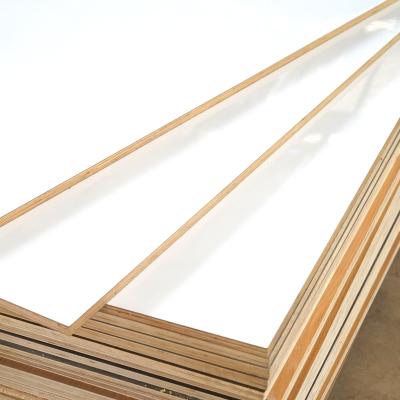
Choosing wood is like choosing an object: they may look similar, but a closer look reveals stark differences! Today, let's discuss these two "twin brothers" of plywood and multilayer, and put an end to your wood selection dilemma! In short: they look alike, but they're fundamentally different!
Both plywood and multilayer are made of wood veneers bonded together with glue. At first glance, they might seem similar, but in reality, their manufacturing processes and final performance differ dramatically. Plywood, you might think of it as a "single-sided hero," is typically made of an odd number of veneer layers laminated alternately, with the outermost layer having the same grain direction. Think of it like building a house: bricks stacked layer by layer. While strong, their bending strength depends primarily on the grain direction of the outermost layer.
What about multilayer? It's more like a model of "teamwork." It's made of multiple layers of veneer laminated in a crisscross pattern, with each layer's wood grain oriented in a different direction. This gives it greater overall stability and bending strength. It's like a house built with reinforced concrete: it's supported in all directions, making it naturally earthquake-resistant!
Thus, the advantages of plywood are its relatively low price, excellent surface flatness, and ease of processing. However, its disadvantages are also significant: its relatively weak bending strength, vulnerability to moisture and deformation, and average water resistance. It's like a "vase" with a shiny, beautiful appearance-it looks beautiful, but it can't withstand the elements.
Multi-layer board, on the other hand, offers superior stability, high bending strength, and impact resistance, resulting in superior overall performance. However, it's also more expensive and more difficult to process than plywood. It's like a martial arts master with profound inner strength: while its appearance may not be as impressive, its strength is undeniable!
So, how do you distinguish between them? It's actually quite simple! First, look at the appearance. Plywood's surface is typically smooth and even, with a consistent grain direction; multi-layer board may have a slightly rougher surface with staggered grain directions. Secondly, you can observe the cross-section of the board. Plywood has fewer layers, with clear boundaries between the layers; multi-layer board has more layers, with more blurred boundaries between the layers. Finally, you can weigh the board by hand; multi-layer board is generally heavier than plywood.
Of course, this is just a simple way to distinguish them; more advanced identification requires specialized tools and experience.
As for application, plywood is generally used in furniture making, packaging, and other applications where strength is not a priority; multi-layer board is more suitable for flooring, furniture, and interior decoration, where strength and stability are more important.
Finally, the choice between plywood and multi-layer board depends on your specific needs. If you have a limited budget and are not demanding high-performance board materials, plywood is a good choice; but if you seek higher quality and stability, multi-layer board is undoubtedly the better choice. Remember, the best solution is what suits you! Don't be fooled by those fancy advertisements anymore. Be rational and scientific when choosing boards!