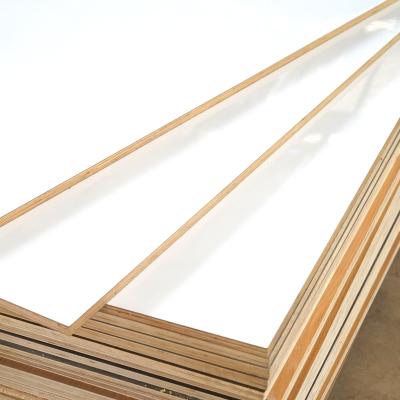
Particleboard uses high temperature and high pressure to compress materials such as wood chips and veneers into a solid board. Its compact structure and stable dimensions make it suitable for large-scale production without joints.
Particleboard, an indispensable material in modern furniture manufacturing and architectural decoration, is highly sought after for its unique production process and performance advantages. Its ability to produce large-scale boards without joints is particularly noteworthy. So, how is this secret achieved?
1. Material Composition and Pretreatment
The main raw materials for particleboard include wood chips, veneers, small-diameter wood, and branches. These raw materials first undergo pretreatment processes such as crushing, screening, and drying to remove impurities and control moisture content, preparing them for subsequent pressing and forming. The pretreated wood material is then processed into particles of a specific shape and size, which become the basic building blocks of particleboard.
2. Pressing Process
During the pressing process, pre-treated wood particles are fed into a forming machine and laid out on a formwork in a specific proportion and arrangement. The formwork is then fed into a hot press, where it is pressed under high temperature and pressure. During this process, the spaces between the particles are compressed, while natural adhesives such as lignin react chemically at high temperatures, forming a strong bond. After a period of pressing and cooling, a complete particleboard is created.
3. Performance Advantages and Large-Scale Production
Particleboard's ability to be produced in large sizes without splicing is primarily due to its unique material composition and pressing process. Particleboard's raw materials are widely available, resulting in relatively low costs. Furthermore, the high-temperature, high-pressure pressing process creates a tight bond between the particles within the particleboard, resulting in high strength and stability. This strength and stability prevents particleboard from deforming, cracking, or delamination during processing and use, thus meeting the demands of large-scale production.